The Three Stages of Learning in Dogs
A dog that successfully performs an exercise once or twice has not necessarily mastered it. For learning to become reliable and lasting, it must go through three stages: discovery, confirmation and consolidation.
1. Discovery
The dog discovers what is expected of them. They try, sometimes make mistakes, and gradually understand which behaviour will earn them a reward.
This first stage should take place in a calm environment with few stimuli—in other words, with few sounds, movements, smells or other elements likely to distract the dog.
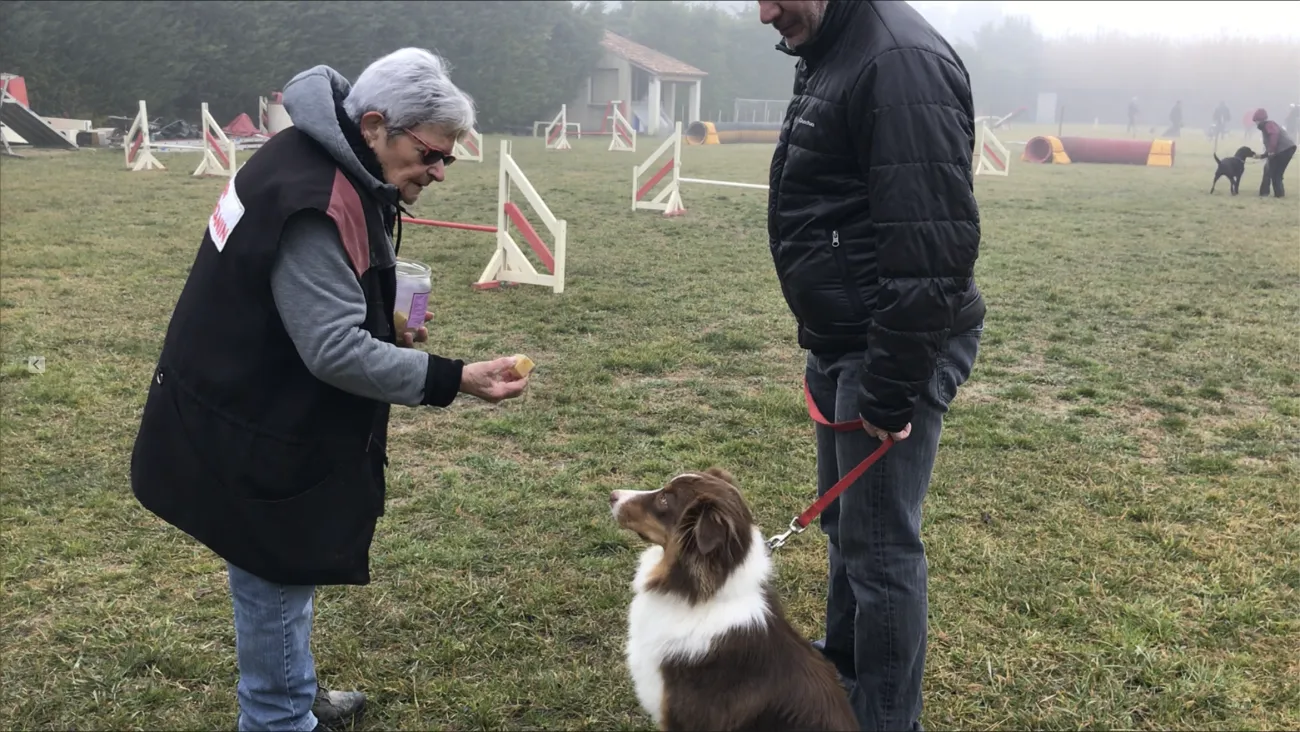
The training field at margeridecanin.fr provides this calm and controlled environment. The dog can therefore concentrate and learn without immediately being placed in a situation that is too difficult.
At this stage, the dog has understood the exercise but has not yet mastered it.
2. Confirmation
The dog must then repeat the behaviour over several sessions. Their response gradually becomes more consistent.
We can then progressively introduce variations in the stimuli:
- change the location;
- introduce a few distractions;
- increase the duration or distance;
- practise in the presence of people or other dogs.
The dog learns that the cue still means the same thing when the environment changes. A “sit” learned at home must also be understood in the garden, on a trail or during a walk.
The level of difficulty should always be increased gradually, according to the dog’s abilities and emotional state.
3. Consolidation
Consolidation is the most important stage, but also the one most often overlooked.
For a behaviour to become truly established, it requires many successful repetitions, spaced over time and practised in different environments.
A successful recall in the garden does not mean that the dog will return when another dog, a person or an animal is present. Training must continue progressively so that the response becomes reliable and lasting.
Some clients believe they have achieved their goal and stop training as soon as the first good results appear. However, the dog has only shown that they are capable of succeeding. The learning has not yet been sufficiently consolidated.
Repetition does not mean organising long training sessions. A few short, regular and positive exercises are generally more effective.
What role does emotional regulation play?
Emotional regulation is involved throughout every stage of learning. A dog cannot learn effectively if they are overexcited, anxious, frustrated or afraid.
In a calm environment, the dog first learns to remain receptive and understand what is expected of them. Gradually varying the stimuli then helps them manage their emotions in increasingly complex situations.
Self-control is part of emotional regulation. It enables the dog to wait, temporarily disengage from something that attracts them or change an immediate response.
However, the aim is not to prevent the dog from experiencing emotions. It is to help them regulate those emotions and return to a calm state more easily.
This work should always take place below the dog’s emotional threshold, at a distance and level of difficulty they can still manage. Through repetition and consolidation, the dog will gradually be able to draw on what they have learned in more stimulating situations.
Support tailored to each dog
Every dog learns differently and at their own pace. Their age, temperament, experiences, motivations and emotional state must all be taken into account.
A thorough assessment makes it possible to create a programme suited to each individual and avoid placing the dog in a situation that is too difficult.
Humans must also learn canine communication
Training is not only about the dog. Humans must also learn to observe, anticipate, reward at the right moment and give clear cues.
To guide their dog effectively, however, they must first learn to understand canine communication. Dogs communicate primarily through their posture, movements, gaze, ear position, mouth, tail and the way they move.
Looking away, licking the nose, slowing down, attempting to move away, freezing or showing tension in the body can indicate discomfort, concern or rising excitement.
These signals must always be interpreted within their context and by observing the dog’s entire body. A single signal is not always enough to understand their emotional state.
Learning canine communication helps us identify whether the dog is ready to learn, experiencing difficulty or approaching their emotional threshold. The human can then adjust the distance, environment or level of difficulty before the situation deteriorates.
This understanding is essential for respecting the dog’s needs, building trust and helping them regulate their emotions more effectively.
The human must therefore adopt the role of a guide—or “leader”, as some people call it. This does not mean dominating the dog, but providing a consistent, reassuring and predictable framework.
My role as a dog trainer and behaviour consultant is therefore to support the entire human–dog team: helping the dog with their learning and emotional regulation, while helping the human understand canine communication and learn how to guide their dog.
Discovery creates understanding. Confirmation builds progress. Consolidation and repetition allow learning and emotional regulation to become firmly established.