
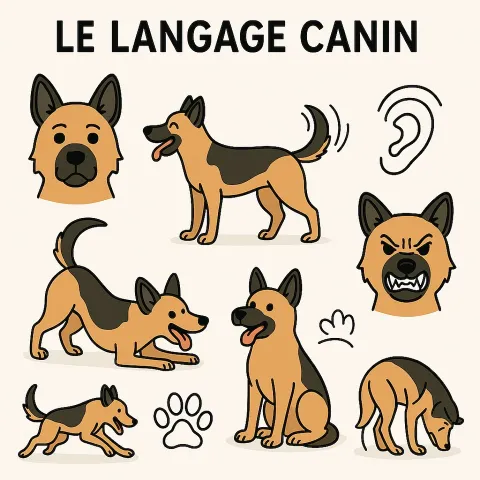
🐶 Decoding Canine Body Language
Dogs do not speak our language, yet they communicate constantly. Their postures, gazes, movements, and attitudes express their emotions. Learning to read them means building a relationship based on trust and mutual understanding.
A Primarily Body-Based Language
Dogs communicate through their bodies: ear position, tail carriage, gaze, posture, breathing… Every detail reflects a specific emotional state. To observe is already to begin understanding.
🐾 “A dog is always communicating, even when it seems silent.”
Calming Signals
These behaviors are used to avoid conflict or ease tension. Knowing them helps identify stress or discomfort before it escalates.
| Calming signal | Likely meaning |
|---|---|
| Yawning | Attempt to calm a stressful situation |
| Lip licking | Mild discomfort or tension |
| Turning the head away | Desire to avoid conflict |
| Scratching, sniffing the ground | Deflecting attention, releasing tension |
| Shaking off | Releasing accumulated stress |
Reading Emotions Through the Body
Relaxed dog: loose body, moving tail, soft gaze.
Stressed dog: stiff body, low tail, ears back, averted gaze.
Defensive dog: raised hackles, high tense tail, growling, fixed stare.
The Eyes: A Mirror of Emotion
A dog’s eyes are often the most direct reflection of its emotional state. They can express curiosity, joy, fear, calmness, or tension—sometimes in a split second.
| Eye expression | Possible meaning |
|---|---|
| Soft gaze, relaxed eyelids | Calm, trust, relaxation |
| Bright, attentive eyes | Curiosity, alertness, play |
| Averted or avoiding gaze | Calming attempt, discomfort, fear |
| Fixed, intense stare | Warning, defense, tension |
| Whites of the eyes visible (“whale eye”) | High stress, anxiety, discomfort |
| Gentle blinking, half-closed eyes | Calm, appeasement, non-aggression |
A dog’s gaze is never neutral. Looking away is not “guilt,” but an attempt to calm or avoid conflict. Staring directly at an unfamiliar dog may be perceived as a challenge.
🐾 “Respecting a dog’s gaze allows it to be heard without a single word.”
The Tail: An Emotional Barometer
| Position / movement | Meaning |
|---|---|
| High and moving | Alertness or confidence |
| Low or tucked | Fear, insecurity |
| Fast, wide wag | Joy, relaxation |
| Slow, stiff wag | Tension, suspicion |
Sounds and Vocalizations
- Short barks: alert, excitement.
- Whining: discomfort, request for attention.
- Low growl: warning, need for space.
- Howling: loneliness or mimicry.
- Sighing: relaxation or mild frustration.
Common Mistakes
- Punishing a growl (it is a warning, not an attack).
- Interpreting canine emotions through a human lens.
- Forcing interaction with an uncomfortable dog.
- Ignoring stress or warning signals.
Learning to Observe
Observing your dog is like learning a foreign language: first you recognize a few words, then entire sentences. The more you observe, the more natural communication becomes.
🐾 “Dogs don’t speak with words, but they never stop communicating.”