Mental stimulation for dogs: using their nose to help them settle
When we think about “tiring out” a dog, we often think about longer walks, running, playing ball, or going on a long hike.
But dogs also need to use their brain.
This is what we call mental stimulation.
It involves offering activities in which the dog has to:
- search;
- think;
- concentrate;
- make choices;
- solve a small problem.
And for that, their best tool is often… their nose.
```
Why is the sense of smell so important?
Dogs experience a large part of the world through smells.
When a dog sniffs a tree, the edge of a path, or a patch of grass, they are not wasting time: they are gathering information about their environment.
A walk should therefore not only be about covering as much distance as possible. It can also give the dog the opportunity to:
slow down, sniff, explore, and make choices.
Sniffing to develop self-control
An excited dog often tends to:
- pull;
- run;
- jump;
- react very quickly;
- move constantly from one stimulus to another.
An olfactory activity, on the other hand, often requires the dog to:
- slow down;
- concentrate;
- follow information;
- stay focused on a task;
- make decisions;
- avoid reacting immediately to everything around them.
This is why scent work can be an excellent way to develop self-control skills.
Self-control is the dog’s ability not to respond immediately to a desire or impulse.
Gradually, the dog learns:
“Something is happening around me, but I can continue to think and stay focused.”
A tool I also use when working on reactivity
This is also one of the reasons why I use scent work extensively in the rehabilitation of reactive dogs.
A reactive dog can quickly become focused on another dog, a person, a vehicle, or any other trigger.
Their emotional arousal can rise very quickly and the dog may go over threshold:
- staring;
- body tension;
- barking;
- pulling;
- lunging forward;
- difficulty reconnecting with their owner.
As part of an appropriate rehabilitation programme, scent work can become a very useful tool to help the dog:
- shift their attention;
- refocus on a task;
- reduce fixation;
- make better choices;
- gradually regain greater self-control.
The aim is obviously not to hide the problem by systematically keeping the dog’s nose on the ground.
The goal is to use scent-based searching at the right moment, at the right distance, and while the dog remains below their emotional threshold, as part of a broader approach to reactivity.
This can gradually help the dog move from:
“I see the trigger and react immediately.”
to:
“I notice it, but I can still think, search, and make another choice.”
It is this ability to regain mental availability that then allows us to make progress in rehabilitation.
Start simply: let your dog sniff
The first activity is also the easiest.
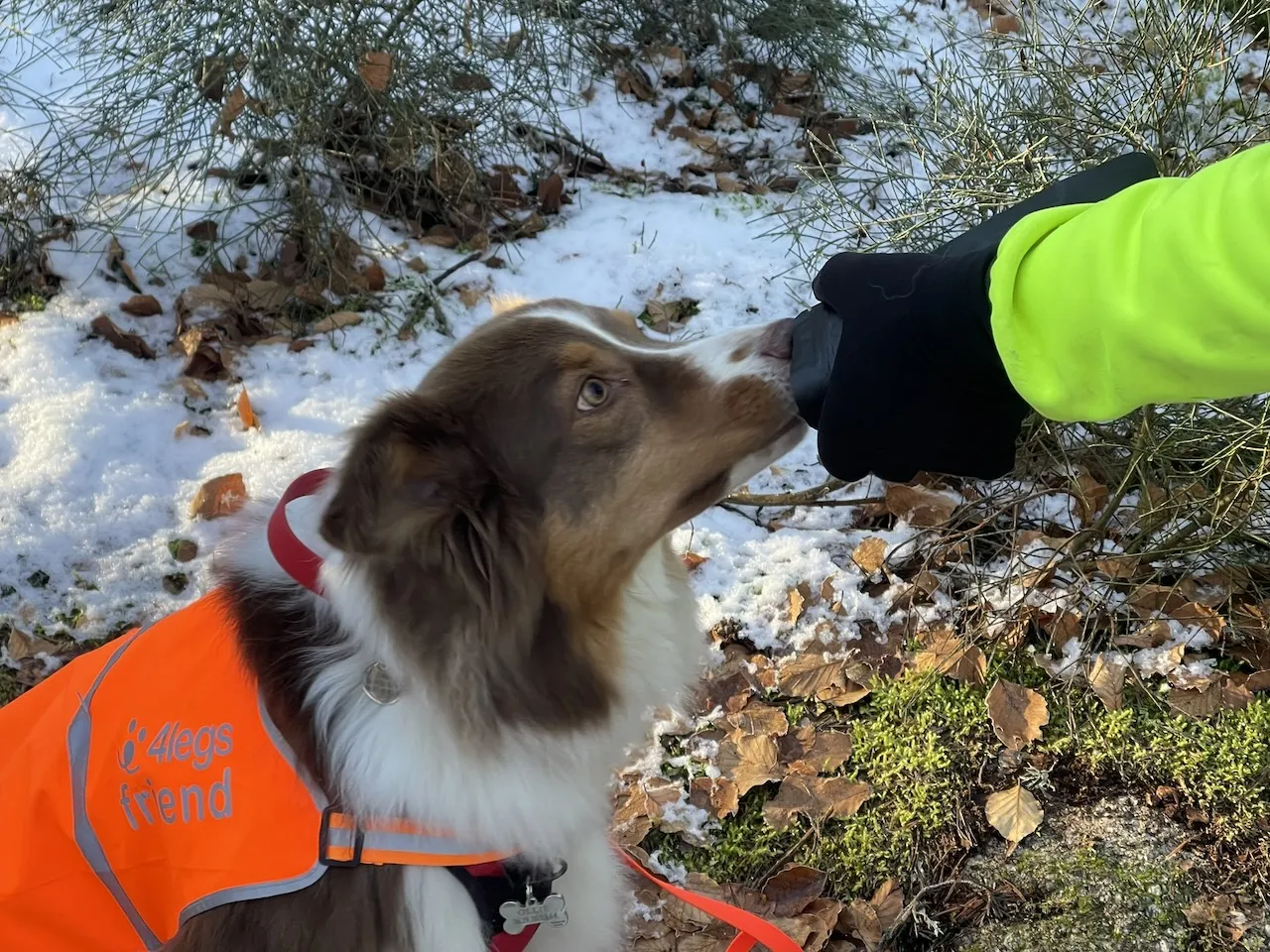
During some walks, give your dog more time to sniff.
It is not always necessary to walk quickly or cover a long distance.
Let your dog:
- stop;
- sniff;
- go back;
- explore;
- follow a scent for a few metres.
These moments allow dogs to use their natural abilities while developing concentration and independence.
Searching for treats
You can then introduce simple searches:
- scatter a few pieces of kibble in the grass;
- hide a treat in a room;
- use several cardboard boxes;
- hide a few rewards in the garden.
Start very easily, then gradually increase the difficulty.
The dog must then use their nose and stay focused on the search.
Searching for an object
You can also hide a toy or an object your dog knows.
At first, the dog can watch where you place it.
Then you can gradually hide it in another room or in the garden.
Once again, the dog learns to search rather than act impulsively.
Moving on to tracking
You can then teach the dog to follow a track.
The first tracks should be:
- short;
- simple;
- fresh;
- in an easy environment.
Then you can gradually increase:
- the length;
- changes of direction;
- the age of the track;
- the surfaces;
- the distractions.
The dog must remain focused on olfactory information for a longer period of time.
This is excellent work for concentration, persistence, and decision-making.
Mantrailing
Mantrailing consists of searching for a person using their scent.
The dog follows the scent information left by that person in order to find them.
The dog must:
- use their nose;
- choose a direction;
- solve difficulties;
- remain focused;
- ignore certain distractions.
In this activity, the dog becomes an active participant.
The human must learn to observe their dog and trust them.
Scent detection
Scent detection works on a different principle.
The dog learns to search for a specific target odour.
They can then search for it:
- among several containers;
- in a room;
- on different objects;
- outdoors;
- in increasingly complex environments.
The dog learns to discriminate between different scents and maintain concentration until they find the correct one.
From simple sniffing to specialised scent work
You can therefore progress very simply:
Sniff freely
↓
Search for treats
↓
Search for an object
↓
Follow a track
↓
Practise tracking or mantrailing
↓
Discover scent detection
There is absolutely no need to progress to the most technical activities.
Simply allowing your dog to use their nose more often is already very beneficial.
A particularly useful tool for highly excitable dogs
With a very active dog, we sometimes think that the solution is simply to increase physical exercise even further.
But constantly increasing running and physical activity may mainly develop… greater endurance.
Mental and scent-based activities offer something different.
They ask the dog to:
slow down, think, persist, and concentrate before acting.
This is precisely what we are looking for when developing self-control.
It is also why scent work can play an important role when supporting certain reactive dogs.
Remember: dogs also need rest
Providing mental stimulation does not mean constantly keeping your dog busy.
Dogs also need to:
- sleep;
- rest;
- recover;
- simply do nothing.
The aim is always to find a balance between:
physical activity, mental stimulation, exploration, and rest.
Key points
Mental stimulation complements physical activity.
And one of the most natural ways to provide it is to allow dogs to use their sense of smell.
From simple sniffing on walks to tracking, mantrailing, or scent detection, dogs learn to:
- search;
- think;
- concentrate;
- make decisions;
- persist;
- manage certain impulses more effectively.
Scent work can therefore become an excellent tool for developing self-control.
And in my work as a canine trainer and behaviour consultant, I also use it as one of the tools for rehabilitating reactivity, as part of an approach adapted to the individual dog, their emotions, and their triggers.
So, on your next walk, you can start very simply:
perhaps walk a little less… and let your dog sniff a little more.
```