Home
education-canine-en-margeride.fr

Navigation principale

  • Home
  • Comportementalisme & Education
    • What behavioral problems can occur?
    • Les activités ludiques & sportives : excellentes continuités de l'éducation
    • Qu'est-ce que l'éducation naturelle ?
    • Qu'est-ce que l'éducation positive ?
    • Le langage canin : clef de la compréhension du chien
    • Massages canin
  • Services
    • Bilan comportemental
    • Cours d'éducation canine
    • Fun and sports dog activities
    • Chien de travail
    • Interventions “ Prévention Morsure “
    • Activités ludiques & sportives
    • Consultation canine en visio
  • Les Chiens de Ma vie
    • Bahia : Terre-Neuve ange de nos enfants !
    • Filou, bichon X - un rescapé remplit d'amour
    • Odin, Bullmastiff : un contemplatif qui a choisit notre maison !
    • Ollie, Berger Australien, une source d'énergie pour tous les projets
    • Uno : X Malinois survitaminé aussi attachant qu'attaché
    • Uzi : Golden Retriever complice des enfants !
  • Diplômes
  • Tarifs 2025
  • Conseils Pratiques
    • Adapter les activités à la condition physique
    • Apprendre à marcher en laisse sans tirer
    • Bien ajuster et habituer son chien au harnais
    • Bien choisir le collier ou le harnais selon la morphologie de son chien
    • Chien en dépression que faire ?
    • Collier plat ou harnais ?
    • Gérer l'arthrose chez son chien
    • Habituer son chien à porter un collier ou un harnais
    • Jeux de réfléxions pour chiens
    • La dysplasie : pathologie courante, pas une fatalité !
    • La surveillance du poids de son chien : un réflexe indispensable pour sa santé !
    • Le collier électrique... est-ce une bonne idée ou un leurre d'éducation ?
    • Le pelage du chien : indicateur de son état de santé & entretien régulier
    • Les différents harnais : comparaisons & contextes
    • Les différents types de laisses et leurs usages
    • Nécessité et biens faits de la balade régulière du chien
    • Pratiquer un sport avec mon chien : est-ce une bonne idée ?
    • Précautions Période de chasse
    • Qu'est-ce qu'un Hot Spot et comment le traiter ?
    • Quelle alimentation pour son chien ?
    • Transport en voiture : que dit la loi ? (et le bon sens)...
  • Adresses Utiles & recommandées
    • Cabinet Vétérinaires Gatavet
    • Cabinet Vétérinaire de la Montagnette
    • Educ M'ouaf
    • Symdog
    • Formateur Chiens au Troupeau - Etienne Serclérat
    • Temps des Paluns
  • Recommandations Littérature canine
    • Comprendre Les Chiens
    • Guide pratique du comportement du chien
    • Le monde secret du chien
    • Tout ce que mon chien veut me dire
Menu du compte de l'utilisateur
  • Log in

Breadcrumb

  1. Home
  2. Getting Your Dog Used To Wearing a Collar or a Harness

Member for

8 months 1 week
By Pascal , 24 December 2025
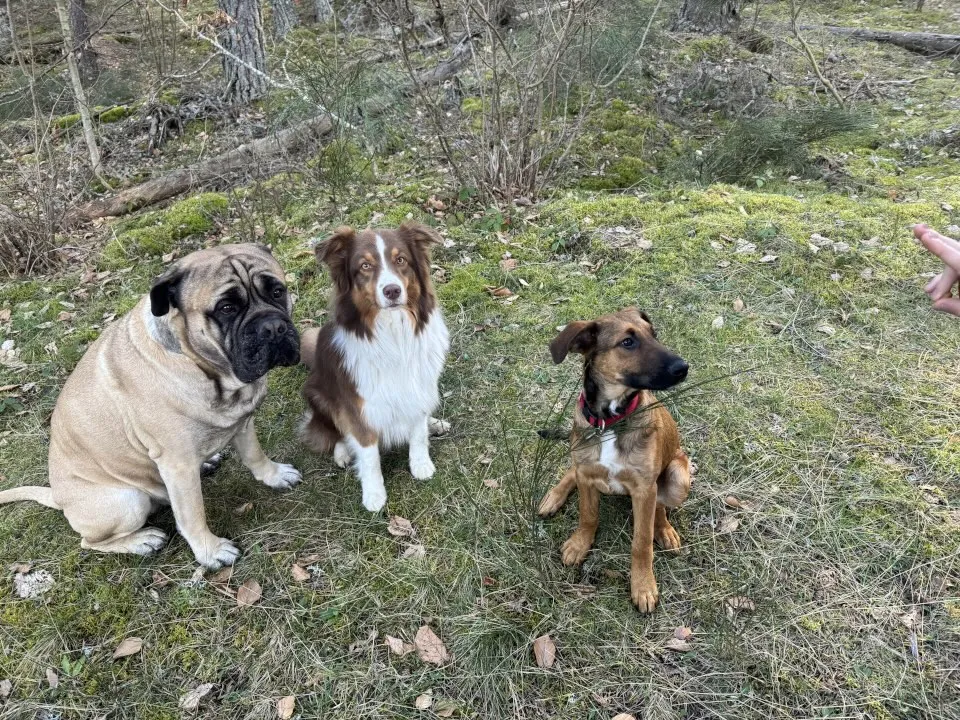
The Dog Trio : Odin, Ollie & Uno

🐶 Helping your dog get used to wearing a collar or a harness

Putting a collar or a harness on a dog may seem trivial, but for the dog it is often a new and sometimes uncomfortable sensation.
Some puppies or adopted dogs may stiffen up, struggle, or even panic at the mere sight of the equipment.

With gradual exposure and gentleness, however, it is very easy to turn this into a pleasant experience.


💡 Why do some dogs refuse a collar or a harness?

There can be several reasons:

  • Lack of familiarity: the object is unfamiliar, and anything new can be perceived as a constraint.
  • A past negative experience: a collar that was too tight, rough handling, or painful pulling.
  • Poor fit: a harness that is too heavy or rubs, or a collar that interferes with breathing.

💬 For a dog, the goal is not simply to tolerate the harness, but to find comfort and meaning in it.


🧠 Learning step by step

🪶 Step 1: Positive discovery

Place the collar or harness on the ground.
Let the dog sniff it, touch it, walk around it freely, without any pressure.
Each time the dog approaches it calmly → reward (gentle voice, treat, petting).

➡️ Goal: the dog associates the object with something pleasant.


✋ Step 2: Contact without fastening

Gently hold the equipment in your hands and let it lightly brush the neck, shoulders, and back.
Always stay calm and kind.
Reward again!
Do not try to fasten it yet — this stage is only about desensitisation to touch.

➡️ Goal: the dog remains relaxed when feeling the collar or harness against its body.


🧷 Step 3: Putting it on

When the dog stays relaxed with contact, put the collar or harness on without fastening it at first, then briefly fasten it.
Reward, then remove it.
Repeat these short, positive handling sessions several times.

💡 Several short and positive sessions are always better than one forced session that creates stress.


🚶 Step 4: Gradual wearing

Let the dog wear the collar or harness for a few minutes at home.
Distract them with a game, a shared moment, or a meal.
This helps the dog quickly forget about its presence.

Gradually increase the duration until the dog accepts it without reacting.


🌳 Step 5: First walk

Once the dog is comfortable, attach the leash.
Start with a few steps in a calm environment: garden, hallway, courtyard.
The goal is not perfect walking, but to create a positive experience.

If the dog stiffens, pulls back, or freezes:

  • stay calm,
  • do not pull on the leash,
  • gently encourage the dog with a treat or a cheerful voice.

➡️ Every outing should be an emotional success, not a constraint.


⚠️ Mistakes to avoid

  • Forcing a dog to put on the equipment when they are showing fear.
  • Using a collar or harness that is too tight or poorly adjusted.
  • Associating the harness only with stressful outings (car, vet, rain, etc.).
  • Punishing a dog who refuses — this only reinforces fear.

💬 Trust always comes before cooperation.


🧭 In summary

StepGoalGood practice
1. DiscoveryCuriosity and trustLet the dog explore freely
2. ContactAccept touchReward calm behaviour
3. Putting it onTolerate wearing itShort, positive handling
4. Gradual wearingGet used to wearing itDistract and praise
5. First walkAssociate with a pleasant outingCalm, patience, rewards

💬 In conclusion

Helping a dog get used to wearing a collar or harness is above all a matter of trust.
It is not about “forcing acceptance”, but about helping the dog understand that this object is synonymous with walks, safety, and shared enjoyment.

“A dog who chooses to cooperate is a dog who trusts.” 🐾

📍 Contact details

Pascal Flork
Éducation Canine en Margeride
678, route du Lioubeau
48600 Auroux, France

📧 pascal@education-canine-en-margeride.fr
📞 +33 6 19 36 03 64
🌐 education-canine-en-margeride.fr

English spoken


🚗 Service area

Margeride, Lozère (48) and neighboring departments:
Haute-Loire (43), Ardèche (07).
Sessions at home, outdoors, or on a secure training field.
Online consultations available for all geographically distant areas.

📞 Call ✉️ Request an appointment

Menu Légal

  • Demande de rendez-vous
  • Contact
  • Mentions légales
  • CGV
  • CGU
  • Politique de confidentialité

Menu général

  • Home
  • Comportementalisme & Education
  • Services
  • Les Chiens de Ma vie
  • Diplômes
  • Tarifs 2025
  • Conseils Pratiques
  • Adresses Utiles & recommandées
  • Recommandations Littérature canine

education-canine-en-margeride.fr
is a service developed by Pascal Flork.

SIRET: 440 900 561 00034
For more details, please visit the Contact page.

© 2025 — Website design by Pascal Flork.

Powered by Drupal