
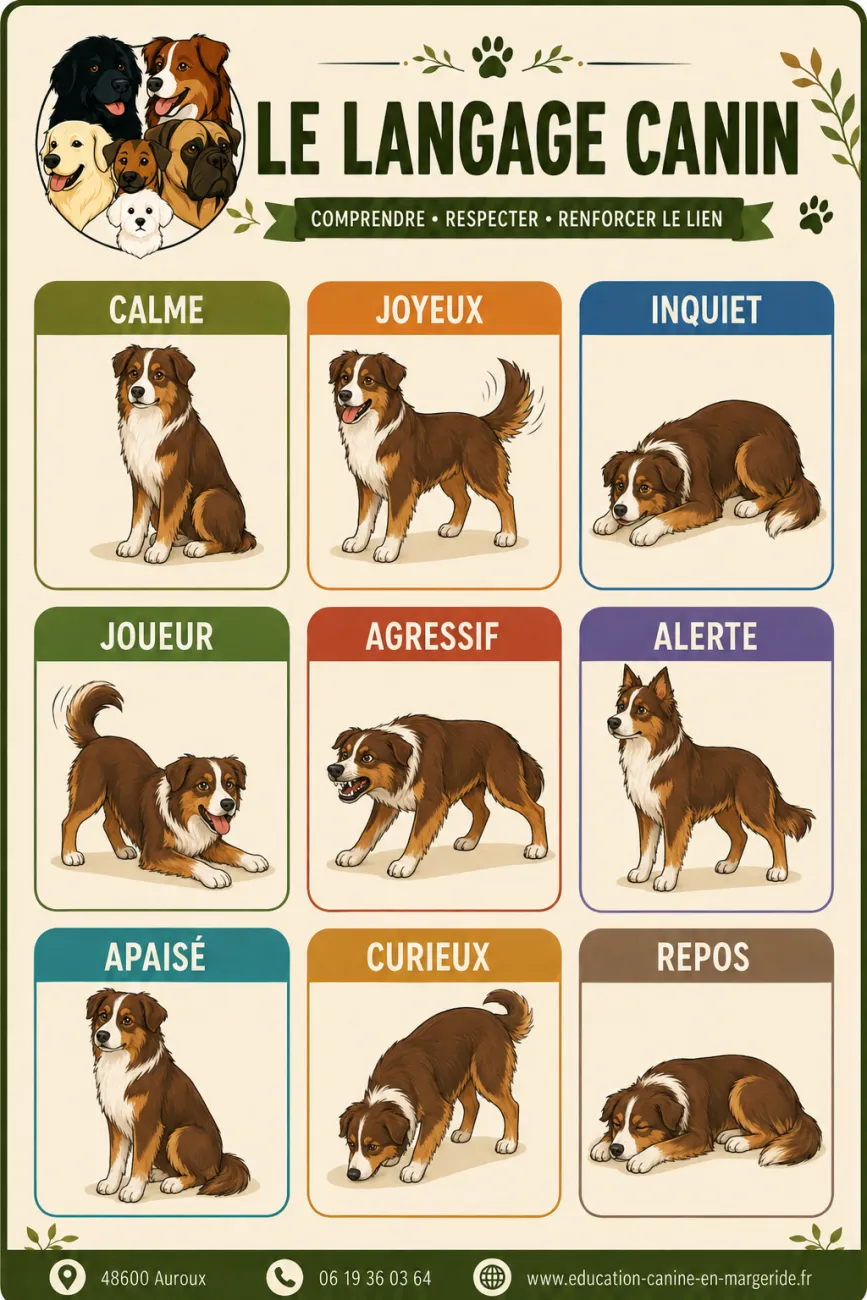
Emotions in dogs: excitement, stress, fear and self-control
A dog that barks, pulls on the lead, jumps, growls or seems to stop listening is not necessarily being “disobedient”.
They may simply be overwhelmed by an emotion.
But not all emotions are the same. It is particularly important to distinguish between:
- excitement, often linked to desire, play, anticipation or strong motivation;
- stress, when the dog has to cope with a demanding or difficult situation;
- fear, when the dog perceives a threat or danger.
These states can sometimes produce very similar behaviours, but they should not necessarily be approached in the same way.
Excitement: “I really want it!”
Excitement corresponds to a high level of arousal.
It may appear when the dog:
- sees their favourite ball;
- is waiting for their food;
- sees someone they like;
- notices another dog they would like to interact with;
- is about to go for a walk;
- anticipates an activity they love.
The dog may then run, jump, bark, pull on the lead or have great difficulty staying calm.
This excitement is not necessarily negative. The dog may be happy and highly motivated, while at the same time being so excited that they temporarily lose the ability to control themselves properly.
What role does dopamine play?
Dopamine plays an important role in motivation, anticipation and reward-seeking.
A dog that loves playing with a ball may, for example, become very excited as soon as they see it, even before it is thrown.
Dopamine therefore contributes, among other things, to this mechanism:
“I want to get something.”
However, there is no simple “dopamine threshold” that can be used to measure a dog’s level of excitement.
In practice, it is much more useful to ask:
Is my dog still able to think despite their excitement?
Stress: “This situation is difficult to deal with”
Stress is a response of the body when it has to adapt to a particular situation.
It is not always negative. Something new, a difficult exercise or physical activity can produce a certain level of arousal without necessarily putting the dog in difficulty.
The problem mainly appears when stress becomes:
- too intense;
- too frequent;
- too prolonged;
- or when the dog is no longer able to recover properly.
Various signs may then be observed:
- panting;
- agitation;
- heightened vigilance;
- difficulty concentrating;
- yawning;
- lip or nose licking;
- trembling;
- attempts to move away;
- unusual reactions.
What role does cortisol play?
Cortisol is involved in the body’s physiological response to stress.
It is often described as the “stress hormone”, but this is an oversimplification.
An increase in cortisol indicates that the body is being challenged, but on its own it does not tell us precisely what the dog is feeling.
Above all, there is no universal cortisol level that allows us to say that a dog has just crossed their emotional threshold.
For an owner, the dog’s behaviour therefore remains the most useful indicator.
Fear: “I want to protect myself”
Fear appears when the dog perceives something as dangerous or threatening.
Faced with this emotion, the dog may try to:
- move away;
- flee;
- hide;
- freeze;
- increase the distance;
- or, if they feel unable to escape, threaten or attack.
A dog that growls or barks at another dog does not necessarily want to approach them.
On the contrary, they may be trying to say:
“Stay away from me.”
This is an essential difference compared with some behaviours linked to excitement.
Excitement and fear can nevertheless look very similar
This is where things can sometimes become difficult for the owner.
An excited dog may:
- pull;
- bark;
- lunge;
- stare at something.
An anxious or frightened dog may show exactly the same behaviours.
This is why we need to look at the whole dog and the context.
Example of an excited dog
The dog sees another dog and:
- tries to get closer;
- jumps;
- pulls towards the other dog;
- appears highly active;
- seeks interaction.
The main issue may be frustration caused by being unable to reach the other dog.
Example of an anxious or frightened dog
The dog sees another dog and:
- becomes stiff;
- stares;
- sometimes tries to move backwards;
- barks or growls when the other dog approaches;
- tries to maintain a safe distance.
In both cases, the dog may pull and bark.
But the emotion causing the behaviour is not the same.
The emotional threshold
Whatever the emotion, there comes a point when its intensity becomes too great for the dog to continue thinking easily.
This is often referred to as the emotional threshold.
As long as the dog remains below this threshold, they may still be able to:
- observe;
- take a treat;
- shift their attention;
- respond to their owner;
- make different choices.
When the emotion becomes too intense, the dog may:
- bark intensely;
- pull;
- freeze;
- flee;
- lunge towards the stimulus;
- refuse food;
- appear no longer able to hear their owner.
At that point, asking for more obedience is often ineffective.
The threshold is not the same for every emotion
With a dog that is highly excited by a ball, for example, we may try to reduce the intensity of the game and work on returning to a calmer state.
With a dog that is afraid of another dog, the priority will instead be to increase the distance and help them feel safe again.
With a dog that is frustrated because they cannot approach another dog, we can gradually work on waiting, disengagement and the ability to shift attention.
This is why it is essential to ask:
“What emotion lies behind the behaviour?”
What is self-control?
Self-control is the dog’s ability not to respond immediately to a desire or impulse.
For example:
- waiting before getting out of the car;
- not immediately running towards another dog;
- waiting a few seconds before receiving food;
- shifting attention away from a ball;
- returning to their owner despite a distraction.
Self-control is particularly important when the dog is excited or highly motivated.
But when a dog is experiencing intense fear, asking for more self-control is not always the priority.
A frightened dog first needs to feel safe enough to be able to learn.
Two dogs pulling towards another dog: two different situations
Imagine two dogs that notice another dog.
The first pulls because they desperately want to go and play.
The second pulls, barks and lunges forwards because they are trying to keep the other dog at a distance.
From the outside, their behaviours may look similar.
Yet:
the first dog is mainly excited and frustrated;
the second may be anxious or afraid.
The training approach will therefore need to be different.
How can you help your dog?
When the dog is highly excited
- reduce the intensity of the situation;
- take regular breaks;
- reinforce calm moments;
- gradually teach the dog to wait;
- work on disengagement and giving things up;
- alternate activity and recovery.
When the dog is frightened or highly stressed
- increase the distance;
- avoid forcing the dog to confront what frightens them;
- allow them to move away;
- work progressively;
- associate the situation with positive experiences;
- respect the dog’s pace.
In every case, dogs learn better when they remain below their emotional threshold.
Be aware of emotional build-up
A dog’s emotional state also depends on what they have experienced beforehand.
A day involving an unusual car journey, a visit to the vet, several encounters with other dogs, lots of noise and little rest can make a dog much more sensitive.
One additional minor difficulty may then trigger a much stronger reaction than usual.
It is therefore important to consider the whole day, not just the event that has just triggered the reaction.
Key points
Excitement, stress and fear are not the same thing.
Excitement can be linked to a positive experience: play, reward, social interaction or anticipation.
Fear is linked to the perception of danger or a threat.
Stress corresponds to the mobilisation of the body when it has to adapt to a demanding situation.
Dopamine is involved, among other things, in motivation and the anticipation of reward.
Cortisol is involved in the physiological stress response.
But there is no precise dopamine or cortisol level that can simply tell us whether a dog has crossed their emotional threshold.
The best indicator remains the dog’s behaviour.
Before trying to correct a reaction, one question is therefore essential:
“Does my dog want to move towards this situation, or are they trying to protect themselves from it?”
Understanding this difference helps us identify the emotion behind the behaviour and adapt the support we provide to the dog.