
2006-2018
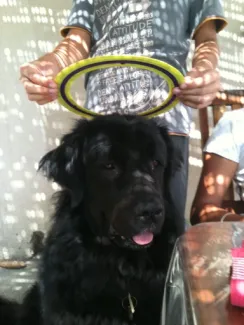 Bahia, the Newfoundland who grew up with our children
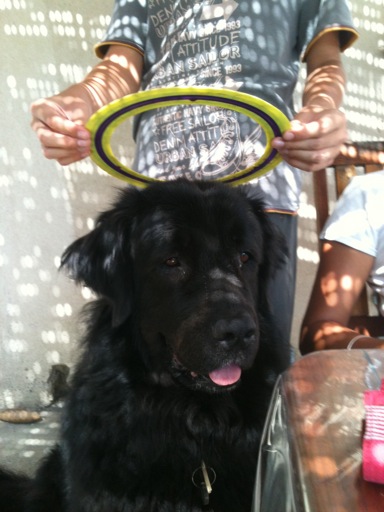
Bahia was (almost) a saint to us. She joined our family just a few weeks after Uzi’s passing.
Playful, affectionate, gentle, expressive, she also knew how to stand her ground. An incredible temperament. From the very beginning, I took charge of her training. The breeder had given me one major—and excellent—piece of advice: “A dog like this must walk at heel, because she will become massive.” The work was long (18 months), but fruitful. Bahia earned my trust when we went out, and I earned hers as well. The leash became nothing more than an accessory to reassure people in the street when faced with a 50-kg molossoid.
People say that big dogs need big spaces. That’s true: a big space next to me or the family—and in the trunk of the car too. She never left our side. Very placid, yet always willing to take part in an activity, especially long walks or swimming.
But beautiful stories also have obstacles. My wife and I had concerns about her gait and joints. Our excellent veterinarian, Patrick Chetcutti, decided to take X-rays. The diagnosis came back: femoral dysplasia, stage E, the worst… and she was only eight months old! Having experienced our previous loss, Dr. Chetcutti preferred to warn me that, in some cases, life expectancy did not exceed five years. He began to look for what could be done (at the time) for large dogs—but above all, he gave me the best advice possible: the best thing is to make her walk, swim, and walk some more, so she can build as much muscle as possible. That way, if surgery ever became an option, her muscles would help compensate.
Day after day, during my periods of working from home, a ritual took shape. A good 1–2 hour outing every day (good for both of us), whatever the weather!
We shared 12 years of incredible happiness (not bad for a five-year life expectancy in her case!). Our two children literally grew up with her—from ages 7 to 19 for our son, and 5 to 17 for our daughter. She was everything I could have hoped for in a relationship with a dog. One example among many: during my daughter’s teenage years, she fell ill; Bahia changed her habits, no longer staying with me in my workspace, but keeping watch between my daughter and me—never too far away. With the knowledge I have today, I can explain that canine sense; at the time, for us, it felt magical.
Toward the end of her life—about a year before her passing—her joints caused her increasing pain, of course, despite care, daily walks, anti-inflammatories, supplements, and weight management. Then, as if by providence, my wife heard about Laëtitia from “Temps des Paluns,” who had just set up a hydrotraining activity.
Hydrotraining can be used both for sporting dogs preparing physically (e.g., agility, canicross) and for dogs in situations like Bahia’s—and even worse. Laëtitia worked miracles, with invaluable warmth, listening, and advice. Without a doubt, we owe her an extra year of life that we shared with Bahia.
She did not pass away from her dysplasia—which we never had operated on—but from a cerebral accident, one evening after a hot day… just after a short walk adapted to her condition… her last, certainly, but what she loved most to do with her family. She occupied a large place—not only physically.