Heatstroke in dogs: how to prevent it, recognise the signs, and act quickly
During periods of hot weather, dogs are particularly vulnerable. Unlike humans, dogs sweat very little and regulate their body temperature mainly through panting. When this mechanism is no longer sufficient, their body temperature can rise rapidly and cause heatstroke.
Heatstroke is a genuine veterinary emergency. It can cause severe damage to several organs and, in the most serious cases, can be fatal.
```
Why do dogs cope less well with heat?
Dogs mainly lose heat by panting. When the outside temperature is high, the air is humid, or the dog is exercising intensely, this cooling process becomes less effective.
Contrary to a common misconception, heatstroke does not only occur in a car left in the sun. Physical exercise can also cause heatstroke, even when the outside temperature does not appear extremely high.
Some dogs are particularly vulnerable:
- brachycephalic dogs with short muzzles, such as Bulldogs, Pugs or Boxers;
- overweight dogs;
- older dogs;
- dogs with respiratory or heart problems;
- dogs that are not accustomed to physical exercise;
- dogs with very thick coats;
- more generally, any dog exposed to intense exercise when the temperature or humidity is high.
How can heatstroke be prevented?
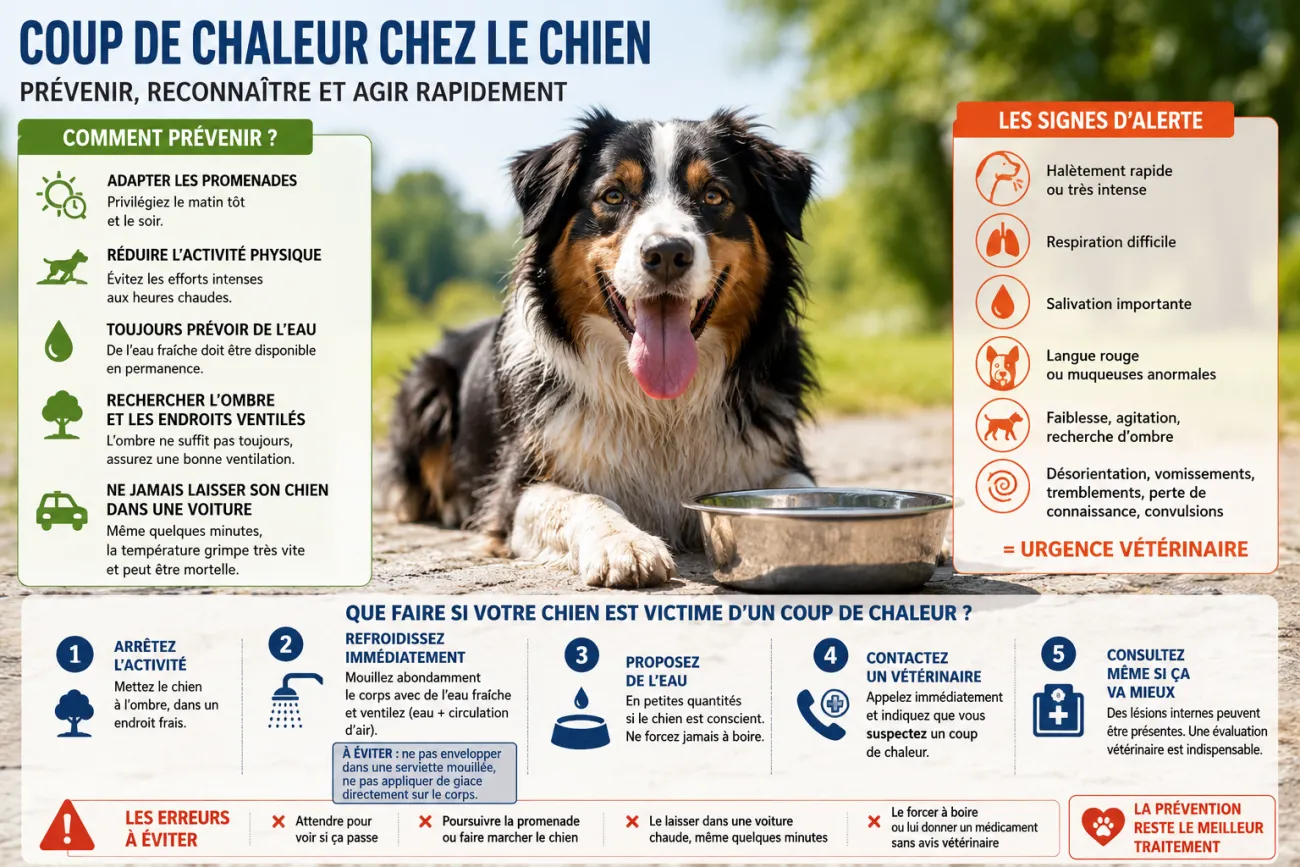
Adapt walking times
During hot weather, favour walks early in the morning and late in the evening.
When temperatures rise significantly, a short and calm morning walk is preferable to prolonged physical activity during the hottest part of the day.
Humidity, lack of wind and direct sun exposure must also be taken into account: the temperature shown on the thermometer is not the only risk factor.
Reduce physical activity
Running, playing, canicross, accompanying a bicycle, repeatedly chasing a ball, or simply walking for a long time can generate a great deal of body heat.
A dog that is highly motivated by play or activity will not necessarily stop on their own before they get into difficulty.
In hot weather, it is therefore preferable to greatly reduce both the intensity and duration of activities.
Always carry water
Dogs should always have access to clean, fresh water.
When going for a walk, remember to take:
- water;
- a bowl or suitable drinking bottle;
- enough water to also wet the dog if necessary.
Look for shade and well-ventilated areas
Favour forest paths, shaded areas and places where the air can circulate.
However, be careful: shade is not always enough when it is very hot. A dog resting in the shade but in a poorly ventilated area can still overheat.
Never leave a dog in a car
Never leave a dog alone in a car in hot weather, even:
- for only a few minutes;
- in the shade;
- with the windows slightly open.
The temperature inside a vehicle can rise extremely quickly and become fatal.
Be careful during car journeys too
A poorly ventilated car, a transport crate exposed to direct sunlight, or a boot that is insufficiently air-conditioned can become dangerous.
Make sure that cool air is actually reaching the area where the dog is travelling.
How can you recognise heatstroke?
The earlier heatstroke is recognised, the better the chances of recovery.
Pay particular attention to:
- unusually rapid or very intense panting;
- difficulty breathing;
- excessive salivation;
- a very red tongue and gums, or abnormal colouring of the mucous membranes;
- unusual agitation;
- constantly seeking shade or cooler areas;
- suddenly slowing down or refusing to continue;
- unusual weakness.
At a more advanced stage, the following may appear:
- an unsteady gait;
- disorientation;
- vomiting or diarrhoea;
- severe lethargy;
- trembling;
- loss of consciousness;
- seizures.
These signs constitute a veterinary emergency.
What should you do if your dog is suffering from heatstroke?
Move the dog to a cool place immediately, begin cooling, contact a veterinarian, and continue cooling during transport whenever possible.
1. Stop the activity immediately
Move the dog into the shade, to a cool place and, if possible, somewhere well ventilated.
Do not ask the dog to keep walking if they are already struggling. Keep any additional effort to an absolute minimum.
2. Begin cooling immediately
Do not wait until you reach the veterinary clinic before starting to cool the dog.
Wet the dog’s body thoroughly with cool water and increase airflow using a fan, moving air, or air conditioning.
The combination of water + airflow helps remove heat from the body.
Be careful with inappropriate cooling methods
Do not wrap the dog in wet towels.
A wet towel left wrapped around the body can reduce evaporation and trap some of the heat.
Also avoid applying ice or ice packs directly to the dog’s body.
3. Offer water
If the dog is conscious and able to drink normally, offer small amounts of fresh water.
Never force the dog to drink, particularly if they are very weak, disoriented or having difficulty swallowing.
4. Contact a veterinarian immediately
Call your veterinarian or an emergency veterinary service and clearly explain that you suspect heatstroke.
Then transport the dog quickly while continuing, as far as possible, to cool and ventilate them during the journey.
5. Even if the dog appears better: see a veterinarian
This is essential.
A dog may appear to recover after cooling even though internal damage has already occurred.
Severe heatstroke can cause damage to:
- the nervous system;
- the kidneys;
- the liver;
- the cardiovascular system;
- the digestive system;
- blood clotting mechanisms.
Some complications can appear later. A veterinary assessment is therefore still essential after genuine heatstroke.
Mistakes to avoid
- ❌ Do not wait to see whether it gets better on its own.
- ❌ Do not continue the walk in order to get home on foot.
- ❌ Do not leave the dog in a hot car, even for a few minutes.
- ❌ Do not wrap the dog in wet towels.
- ❌ Do not apply ice directly to the dog’s body.
- ❌ Do not force the dog to drink.
- ❌ Do not give medication without veterinary advice.
Prevention remains the best treatment
During periods of extreme heat, it is always better to cancel, shorten or postpone an activity than to take a risk with your dog.
A day without a long walk will not negatively affect your dog’s well-being. On the other hand, overly intense activity in unsuitable conditions can quickly lead to severe hyperthermia.
In hot weather, favour calm activities that require little physical effort:
- search games;
- scent-based activities;
- short training sessions;
- chewing activities;
- problem-solving games;
- activities indoors or in a cool environment.
Finally, observe your dog. Their age, body shape, health, fitness level and ability to cope with heat are individual to them.
In hot weather, adapt the activity to the dog and to the conditions of the day — never the other way round.
Excessive panting, weakness, an abnormal gait, vomiting or disorientation after exposure to heat or physical exertion should raise suspicion of heatstroke.
Move the dog to a cool place, begin cooling immediately with water and airflow, then contact a veterinarian as an emergency.
```